
SMPP Gateway — Direct Protocol SMS Connectivity for Telecom-Grade Messaging
Overview
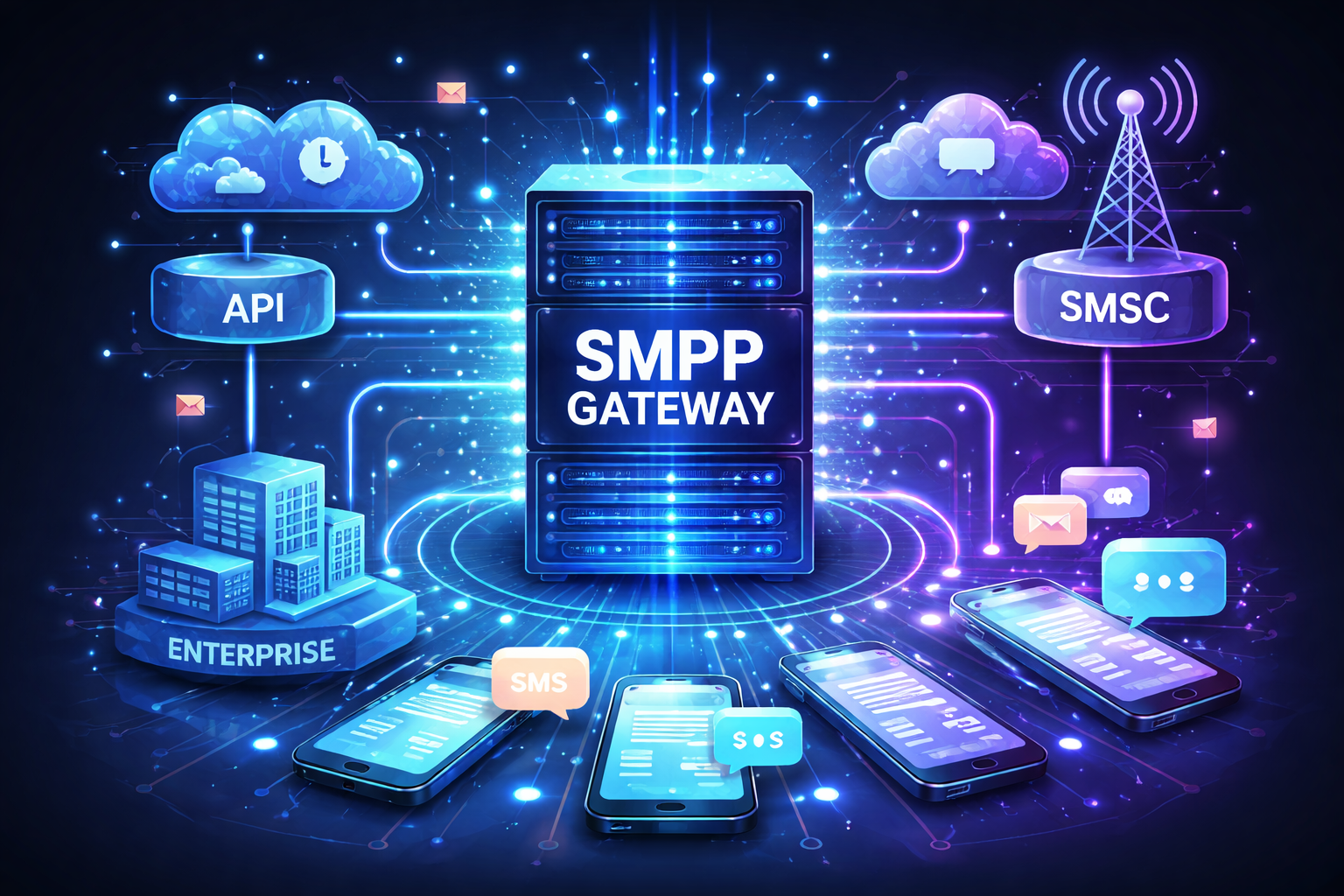
ISIMConnect’s SMPP Gateway provides direct Short Message Peer-to-Peer (SMPP) protocol connectivity for enterprise platforms, SMS aggregators, telecom operators, and high-volume application developers who need to connect directly to Indian operator SMSCs. It supports SMPP version 3.4, binds as transmitter, receiver, or transceiver, and provides real-time delivery reports, making it suited for bulk A2P messaging, OTP delivery at scale, and telco platform integration.
What Is SMPP and When Do You Need It?
SMPP (Short Message Peer-to-Peer) is the industry-standard TCP/IP protocol for direct, high-throughput communication between SMS applications (ESMEs — External Short Messaging Entities) and mobile operator message centers (SMSCs). It is the protocol layer underneath all high-volume commercial SMS delivery.
You need a direct SMPP connection (rather than an HTTP API) when:
Your platform requires throughput above what HTTP-based SMS APIs support reliably
You need sub-second delivery and real-time delivery receipts directly from the SMSC, not an intermediary
You are building or operating an SMS aggregator, telecom platform, or messaging hub
You are integrating with existing telecom infrastructure that already speaks SMPP
For most standard IoT and M2M messaging use cases, ISIMConnect’s M2M SMS Gateway or Consumer OTP Gateway provides a simpler API-based integration above the SMPP layer.
Technical Specifications
Protocol version – SMPP v3.4
Bind modes – Transmitter, Receiver, Transceiver
Transport – TCP/IP
Delivery reports – Real-time DLRs via SMSC
TLS/SSL – Available where operator supports it
Throughput – Limited only by internet connection speed
Concurrent sessions – Up to 5 sessions by default
Operators – Airtel, Jio, Vodafone Idea, BSNL
DLT compliance – Supported for Indian A2P messaging regulations
Key Features
Direct SMPP v3.4 connectivity — no additional protocol translation layer
Bind as transmitter (send only), receiver (receive only), or transceiver (send and receive)
Real-time delivery receipts in standard SMPP DLR format
DLT-compliant sender registration for Indian commercial messaging
Operator choice — Airtel, Jio, Vodafone, or BSNL SMSC connection
REST API also available for platforms that need HTTP fallback alongside SMPP
Common Use Cases
Enterprise bulk SMS platforms integrating directly with Indian operator SMSCs
Telecom operators and MVNOs needing SMPP interconnect
High-volume OTP platforms requiring guaranteed throughput beyond HTTP API limits
SMS aggregators needing direct SMSC routes for Indian traffic
Application developers building real-time notification systems at scale
Frequently Asked Questions
Q: What is SMPP and how is it different from a REST API for SMS?
A: SMPP (Short Message Peer-to-Peer) is a binary TCP/IP protocol that connects directly to the operator’s message center (SMSC) — it is the underlying protocol that REST SMS APIs are typically built on top of. SMPP provides lower latency, higher throughput, real-time binary delivery receipts from the SMSC, and is the correct choice for telco-grade integrations. REST APIs abstract over this and are simpler to integrate but with higher overhead and less direct SMSC visibility.
Q: What SMPP version does ISIMConnect support?
A: SMPP version 3.4, which is the current industry-standard version used by virtually all mobile operators and SMS platforms globally.
Q: Can I receive SMS as well as send through ISIMConnect’s SMPP Gateway?
A: Yes. Binding as a receiver or transceiver allows both sending and receiving SMS. Delivery reports are sent over all available sessions bound as transceiver or receiver.
Q: Is ISIMConnect’s SMPP Gateway DLT-compliant for India?
A: Yes. DLT compliance for Indian commercial messaging — sender ID registration, template registration, and delivery verification — is supported.