Remote SIM Provisioning (RSP) — Over-the-Air eSIM Management for IoT and Enterprise
Overview
Remote SIM Provisioning (RSP) is the GSMA-defined process of installing, activating, switching, and managing mobile operator profiles on eSIM-capable devices over the air — without physically swapping or touching the SIM. ISIMConnect provides RSP infrastructure for IoT and enterprise deployments on Indian and global networks, supporting both the GSMA SGP.22 (consumer) and SGP.32 (IoT) provisioning standards, with direct operator relationships across Airtel, Jio, Vodafone, and BSNL.
What Is Remote SIM Provisioning and Why Does It Matter?
Before RSP, the operator profile on a SIM card was fixed at manufacture. If the operator raised prices, reduced coverage, or the device was redeployed in a new region, the only option was a physical SIM swap — sending a technician to each deployed device. For IoT fleets spanning thousands of devices across multiple locations, that is operationally and financially unworkable.
RSP solves this by making the operator profile software, not hardware. Instead of a fixed, physical carrier relationship locked into the SIM at manufacture, profiles are downloaded, activated, switched, and deleted remotely over the air throughout the device’s operational life — no physical access required.
The practical result: operator selection becomes an ongoing operational decision rather than a permanent manufacturing constraint.
How Remote SIM Provisioning Works — End to End
The RSP process involves several components working in a defined sequence. Understanding the architecture is important for evaluating any RSP provider.
Core Components
eUICC (embedded Universal Integrated Circuit Card) – The SIM hardware that stores and executes profiles. Can hold multiple profiles but only one is active at a time
SM-DP+ (Subscription Manager – Data Preparation+) – Server that prepares, encrypts, and delivers operator profiles to devices
eIM (eSIM IoT Remote Manager) – SGP.32 only — the server-side orchestrator that triggers and manages profile operations across device fleets
IPA (IoT Profile Assistant) – SGP.32 only — the device-side component that receives eIM instructions and interfaces with the eUICC
LPA (Local Profile Assistant) – SGP.22 only — the device-side component that handles consumer-initiated profile downloads
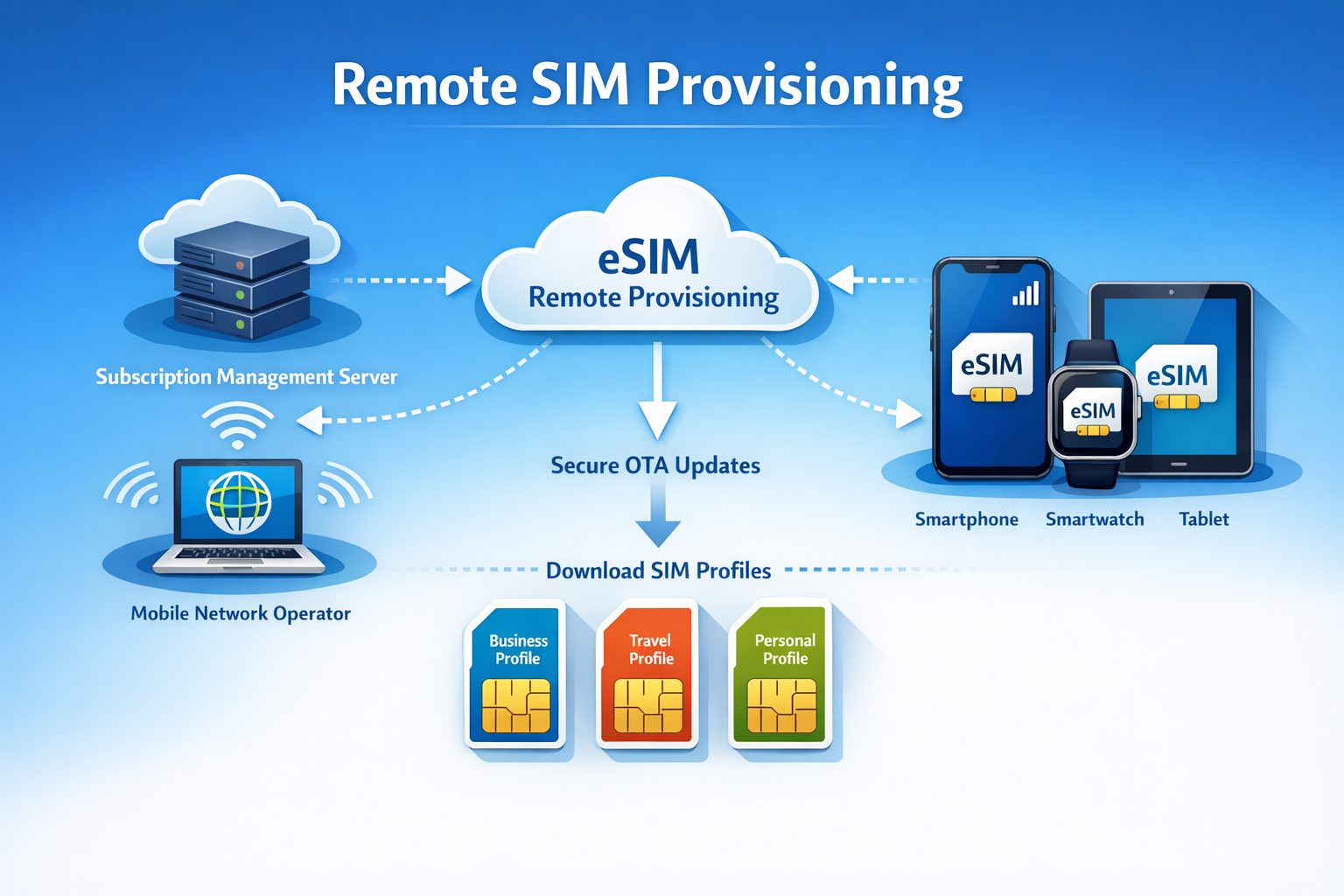
The SGP.32 Provisioning Sequence (ISIMConnect’s IoT RSP)
Bootstrap connection: The device powers on and uses its pre-installed bootstrap profile to connect to the network and reach the ISIMConnect eIM server.
Device registration: The eIM identifies the device by its EID (eUICC Identifier) and checks it against the deployment’s profile assignment.
Profile preparation: The designated operator’s SM-DP+ prepares and encrypts the operator profile for that specific eUICC.
OTA delivery: The eIM instructs the IPA on the device to initiate a profile download from the SM-DP+. The profile is delivered over the air, encrypted, and installed on the eUICC.
Activation: The eIM triggers profile activation — the device is now connected on the designated operator network.
Lifecycle management: For the life of the device, profile switches, disablement, or deletion are handled the same way — triggered remotely via eIM, executed on the eUICC without physical access.
What ISIMConnect Provides for Remote SIM Provisioning
ISIMConnect delivers RSP as a fully managed infrastructure service — not a hardware-only product. The complete RSP stack includes:
SGP.32 eIM (eSIM IoT Remote Manager): Managed server infrastructure orchestrating profile downloads, activations, and lifecycle operations across your device fleet. See eIM →
SGP.32 SIM and eSIM: GSMA-compliant eUICC hardware in plastic SIM (2FF/3FF/4FF) and MFF2 embedded form factors. See SGP.32 SIM →
Bootstrap Connectivity: Pre-installed provisional profile enabling devices to connect and reach the eIM on first power-on. See Bootstrap Connectivity →
SM-DP+ coordination: ISIMConnect coordinates with operator SM-DP+ infrastructure (Airtel, Jio, Vodafone, BSNL and global operators) — no separate operator integration required on your side.
REST API: Profile lifecycle operations accessible via API for integration into enterprise device management platforms, ERP systems, or operations dashboards.
Connection Management Platform: Centralized dashboard for real-time profile state, connectivity status, and fleet-wide visibility.
Indian regulatory compliance: All RSP and SIM products comply with Indian Government M2M regulations and TRAI norms for M2M connectivity, with SIM OS developed to Indian make/develop requirements.
RSP Use Cases Across Industries
Smart Metering – Long-term profile management for meters spanning multiple utility operator regions
Fleet & Telematics – Operator switching for vehicles crossing state or national borders
Logistics – Profile updates for shipping containers and assets crossing international boundaries
EV Charging – Remote connectivity management as operator commercial agreements evolve
Industrial IoT – Redeployment of sensors and equipment across regions without physical retrieval
Healthcare – Secure, auditable SIM lifecycle management for medical-grade connected devices
Smart Cities – Centralized management of thousands of connected infrastructure sensors
ISIMConnect RSP and Indian Regulatory Compliance
For IoT and M2M deployments in India, RSP solutions must comply with specific regulatory requirements that differ from global deployments:
No permanent international roaming: TRAI regulations prohibit permanent international roaming on Indian SIMs — ISIMConnect’s RSP architecture uses local Indian operator profiles (Airtel, Jio, Vodafone, BSNL) rather than international roaming, keeping deployments fully compliant.
13-digit M2M numbering: Indian M2M regulations mandate 13-digit device numbering — ISIMConnect’s provisioning and SIM products are built for this format.
Indian-developed SIM OS: ISIMConnect’s SIM products comply with Indian Government M2M norms for domestically developed SIM operating systems.
SAS-accredited personalization: SIM personalization is performed at SAS-accredited sites under GSMA security protocol norms.
Frequently Asked Questions
Q: What is remote SIM provisioning (RSP)?
A: Remote SIM Provisioning (RSP) is the GSMA-defined process of installing, activating, switching, and deleting mobile operator profiles on eSIM-capable devices over the air, without physically touching or swapping the SIM. It enables IoT devices to change operators, activate new connectivity, or get reconfigured remotely throughout their deployed life.
Q: What is the difference between RSP and OTA SIM management?
A: OTA (over-the-air) SIM management updates configuration parameters — APN settings, security keys, SMS settings — on an existing, fixed operator profile. RSP goes further: it can download, install, and switch entire operator profiles on the SIM, changing which carrier the device is connected to. OTA manages the SIM’s settings; RSP manages which operator the SIM belongs to.
Q: Which GSMA RSP standard should I use for IoT devices?
A: SGP.32 is the correct standard for new IoT deployments. SGP.02 (the original M2M standard) requires SMS infrastructure and synchronous device connectivity, which many modern LPWAN and NB-IoT devices do not support. SGP.22 (consumer eSIM) requires user interaction. SGP.32 was purpose-built for headless, low-power, intermittently connected IoT devices and is the current GSMA recommendation.
Q: Does ISIMConnect’s RSP work with Airtel, Jio, and Vodafone in India?
A: Yes. ISIMConnect has direct operator relationships with Airtel, Jio, Vodafone Idea, and BSNL, covering RSP profile delivery and M2M connectivity for Indian deployments. Global operator support is also available for cross-border IoT deployments.
Q: Is remote SIM provisioning compliant with Indian M2M regulations?
A: Yes. ISIMConnect’s RSP solution uses local Indian operator profiles (not international permanent roaming), supports the mandatory 13-digit M2M numbering format, and complies with TRAI and Indian Government M2M norms, including requirements for domestically developed SIM OS.
Q: What is the difference between remote SIM provisioning and Multi-IMSI SIM?
A: Multi-IMSI SIM stores multiple pre-loaded operator profiles at manufacture and switches between them automatically on the device. RSP downloads and manages profiles remotely after the device is deployed, using GSMA-standardised infrastructure (SM-DP+, eIM). Multi-IMSI is simpler and needs no server infrastructure. RSP is more flexible — profiles can be added, changed, or removed throughout the device’s life — but requires eIM setup and API integration.
Q: What does ISIMConnect provide as part of its RSP infrastructure?
A: ISIMConnect provides the complete RSP stack as a managed service: SGP.32-compliant eIM server, coordinated SM-DP+ access across Airtel, Jio, Vodafone, and BSNL, bootstrap connectivity, REST API for enterprise integration, and a Connection Management Platform for fleet-wide visibility.