Multi-IMSI eSIM — Embedded Multi-Network SIM for IoT Devices
Overview
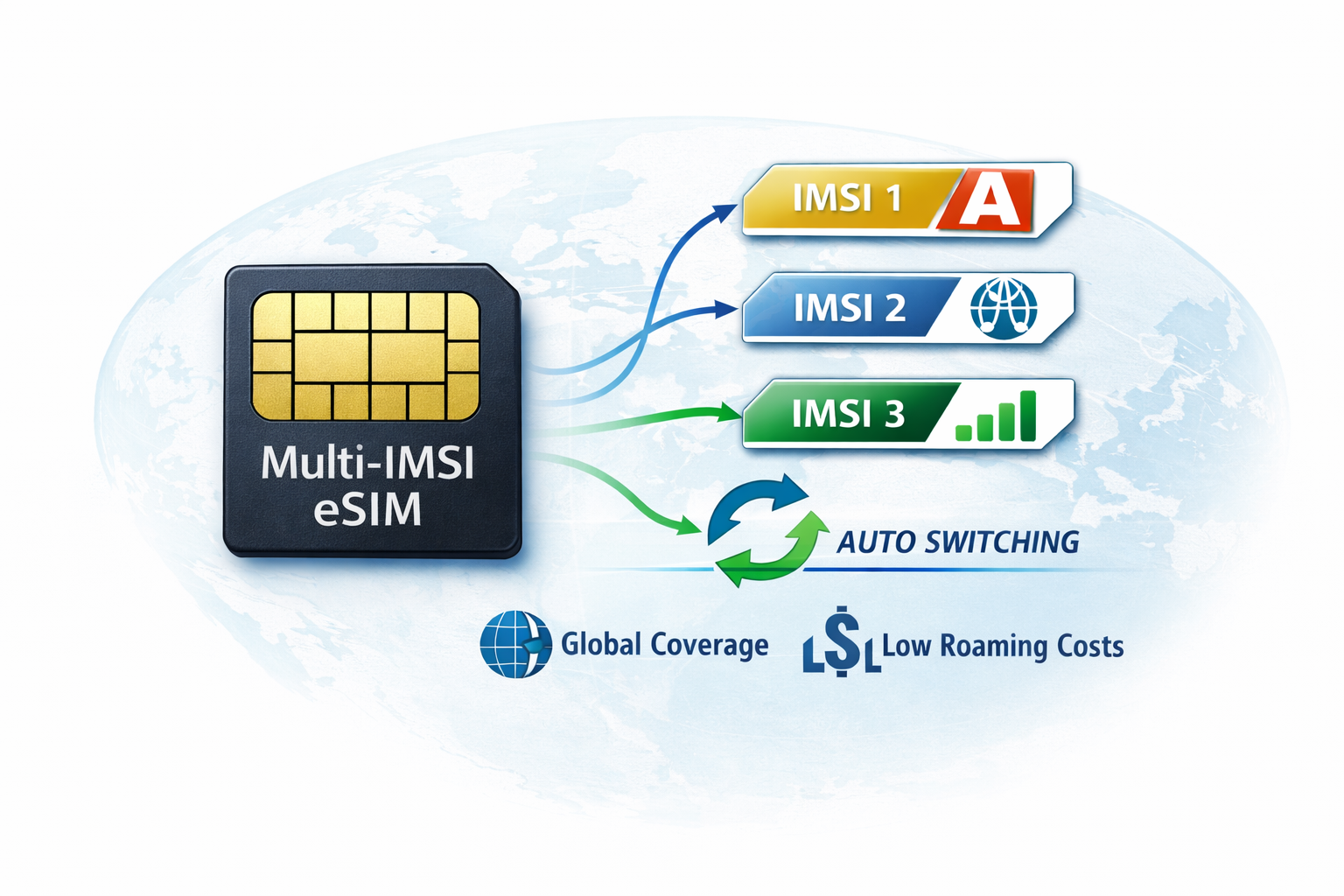
ISIMConnect’s Multi-IMSI eSIM is an embedded SIM — available as an MFF2 chip soldered directly to a device’s circuit board — pre-loaded with multiple network operator profiles at manufacture. Like the Multi-IMSI Plastic SIM, it switches between operator profiles automatically without remote provisioning infrastructure. The embedded form factor makes it suited for compact, ruggedized, or high-vibration hardware where a removable SIM slot is impractical or a security liability.
What Is an MFF2 eSIM?
MFF2 (Machine Form Factor 2) is a surface-mount chip format defined by ETSI standards for industrial and IoT applications. Unlike a plastic SIM card, the MFF2 chip is vacuum-sealed and soldered directly to the circuit board during device manufacturing, making it:
Tamper-resistant: Cannot be physically removed from the device, preventing unauthorized SIM swapping
Ruggedized: Sealed against moisture, dust, and corrosion — suitable for outdoor or harsh-environment deployments
Vibration-tolerant: No removable connector to loosen under constant motion, important for vehicle-mounted or industrial hardware
Longer lifecycle: Rated for extended temperature ranges and operational lifespans compared to removable SIM form factors
How Multi-IMSI Profiles Work on the eSIM
The MFF2 chip functions identically to a standard UICC SIM from a network perspective — it stores multiple IMSI profiles, and a switching applet selects the best available local network when the device powers on or loses connectivity. Because the profiles are pre-loaded at manufacture via SAS-accredited personalization, the device connects to the right network immediately on first power-on, with no user interaction or remote server call required.
Note: the Multi-IMSI eSIM is distinct from an eUICC/SGP.32 eSIM. Both are embedded chips, but eUICC supports remote profile downloads after deployment; the Multi-IMSI eSIM uses pre-loaded fixed profiles. If post-deployment profile management is required, see SGP.32 SIM.
Key Advantages of eSIM Multi IMSI Technology
By combining eSIM technology with Multi IMSI capabilities, businesses gain greater flexibility, network resilience, and operational efficiency. Devices can automatically select the strongest available operator network, reducing downtime and improving service reliability across different regions.
For enterprises managing large-scale IoT deployments, eSIM Multi IMSI SIM solutions simplify connectivity management through centralized platforms. Network profiles can be provisioned, updated, or replaced remotely using Over-the-Air (OTA) technology, minimizing maintenance costs and eliminating the logistics of physical SIM replacement.
The solution is particularly beneficial for smart meters, vehicle tracking systems, POS terminals, industrial automation equipment, CCTV surveillance systems, telematics devices, healthcare monitoring systems, and connected consumer electronics. It also supports domestic and international roaming, making it suitable for global IoT deployments that require seamless cross-border connectivity.
With enhanced security features, encrypted profile management, remote lifecycle control, and support for multiple operator identities, eSIM Multi IMSI technology helps ensure continuous connectivity even in challenging network environments. As businesses increasingly adopt digital transformation and IoT-driven operations, eSIM Multi IMSI SIMs provide a future-ready connectivity framework that supports scalability, reliability, and efficient network management from a single integrated platform.
Specifications
Form factor – MFF2 (surface-mount, solderable)
Standard – ETSI TS 102 671 (MFF2 industrial SIM)
Profile storage – Multiple pre-loaded IMSI profiles
Switching mechanism – On-SIM applet (no remote server required)
Personalization – SAS-accredited facilities, GSMA security protocols
Environmental rating – Industrial-grade — sealed, vibration and corrosion resistant
Profile updates – Fixed at manufacture (not remotely updatable)
Key Benefits of eSIM Multi IMSI SIM
No Physical SIM Card Required
Since the eSIM is embedded inside the device, there is no need for a removable SIM card or dedicated SIM slot. This improves durability and reduces hardware complexity.
Remote eSIM Activation & Management
Devices can be activated remotely using secure eSIM activation systems. Enterprises can manage thousands of devices without manual SIM replacement.
Supports Multiple Operator Profiles
The platform can store profiles from leading SIM providers and telecom operators including:
Airtel SIM card
Jio SIM card
BSNL SIM card
Airtel M2M networks
This ensures stronger connectivity and better uptime across regions.
Ideal for IoT & M2M Applications
The solution is designed for:
M2M SIM deployments
M2M SIM card infrastructure
Airtel M2M SIM card connectivity
Smart meters
GPS tracking systems
POS machines
Industrial IoT devices
Automotive telematics
Smaller, More Secure Design
Because the SIM chip is soldered directly onto the device motherboard, it provides better protection against tampering, vibration, dust, and moisture.
Perfect for Large-Scale Enterprise Deployments
An eSIM provider can remotely manage connectivity for thousands of devices across different locations using centralized eSIM solutions. Businesses can deploy devices globally while maintaining flexible operator selection and secure SIM network management.
Whether you need:
Airtel connection management
Jio connection support
BSNL eSIM services
eSIM application integration
Remote SIM provisioning
SIM provider flexibility
eSIM Multi IMSI technology delivers scalable, secure, and future-ready connectivity for modern IoT ecosystems.
eSIM Benefits for Modern Connectivity
Some major eSIM benefits include:
Remote provisioning
Reduced operational cost
Faster deployment
Improved network redundancy
Better device security
Seamless operator switching
Simplified SIM lifecycle management
eSIM technology is becoming the preferred connectivity standard for enterprises looking to upgrade from traditional SIM card infrastructure to intelligent digital connectivity platforms.
Common Use Cases
GPS trackers and telematics units in vehicles, where vibration and tamper resistance matter
Outdoor environmental and industrial sensors exposed to moisture or temperature extremes
Compact wearable or consumer IoT devices where a SIM slot is not practical
High-security deployments where physical SIM removal is a risk
Globally manufactured devices shipped to multiple regions (single SKU, multi-network)
Frequently Asked Questions
Q: What is the difference between a Multi-IMSI eSIM and an eUICC (SGP.32) eSIM?
A: Both are embedded SIM chips, but they work differently. A Multi-IMSI eSIM holds multiple network profiles pre-loaded at manufacture and switches between them on-device — no remote provisioning needed. An eUICC (SGP.32) eSIM supports downloading and swapping operator profiles remotely after the device is deployed, using GSMA RSP standards. If you need to change operator profiles post-deployment, SGP.32 is the right product.
Q: Can the Multi-IMSI eSIM be updated with new operator profiles after it is soldered in?
A: No. Profiles on the Multi-IMSI eSIM are fixed at the time of manufacture and personalization. The eSIM can switch between its pre-loaded profiles automatically, but new profiles cannot be added remotely.
Q: What makes MFF2 better for outdoor or vehicle IoT deployments than a plastic SIM?
A: MFF2 chips are vacuum-sealed and soldered to the circuit board, making them resistant to moisture, dust, corrosion, and vibration — unlike a removable plastic SIM which sits in a connector that can loosen. MFF2 also cannot be physically removed from the device, which reduces security risk for unattended deployments.
Q: Does the Multi-IMSI eSIM require any provisioning infrastructure to operate?
A: No. Network switching happens entirely on the chip via an embedded applet. There is no requirement for an eIM server, RSP platform, or any remote management infrastructure.
Q: How does ISIMConnect personalize the Multi-IMSI eSIM?
A: ISIMConnect facilitates SIM personalization — loading the IMSI profiles and security keys — at SAS-accredited facilities under GSMA security protocol norms, ensuring the process meets industry-standard security requirements for SIM manufacturing.