
Whitelisting IMEI Verification — Device Identity and Network Access Compliance API
Overview
ISIMConnect’s Whitelisting IMEI Verification API checks whether a device’s IMEI (International Mobile Equipment Identity) is registered and approved for network access in India’s Central Equipment Identity Register (CEIR) — the national IMEI database maintained by DoT. It is used by enterprise IoT operators, device importers, fleet managers, and telecom compliance teams to verify that devices are legally cleared for activation on Indian networks before SIM provisioning.
What Is IMEI and Why Does Whitelisting Matter in India?
The IMEI (International Mobile Equipment Identity) is the unique 15-digit hardware identifier assigned to every mobile and cellular IoT device. Unlike IMSI (which identifies the subscriber/SIM), IMEI identifies the physical device — it does not change when a SIM is swapped.
In India, DoT operates the Central Equipment Identity Register (CEIR) which classifies device IMEIs into:
Whitelist: IMEI is registered, approved, and cleared for network use in India
Blacklist: IMEI is blocked — typically due to theft, fraud, or non-compliance
Greylist: IMEI is flagged — device is in a pending state, often used temporarily while compliance is resolved
Devices with non-whitelisted IMEIs can be blocked from accessing Indian operator networks — including IoT devices imported for enterprise deployments. Verifying IMEI status before SIM provisioning prevents failed activations and compliance violations.
Why IMEI Verification Matters
Without proper IMEI verification, businesses may face:
Unauthorized device usage
SIM misuse
Device cloning concerns
Failed eSIM activation attempts
Compliance challenges
Customer support issues
Operational inefficiencies
IMEI verification provides an additional layer of security before activating SIM cards, eSIM cards, or connected IoT devices.
What the IMEI Verification API Checks
IMEI status – Whitelist / Blacklist / Greylist classification from CEIR
Device type – Mobile phone / IoT device / M2M device classification
Approval status – Whether IMEI is cleared for network access
Block reason – If blacklisted — reason for block (where available)
How the Whitelisting IMEI Verification Process Works
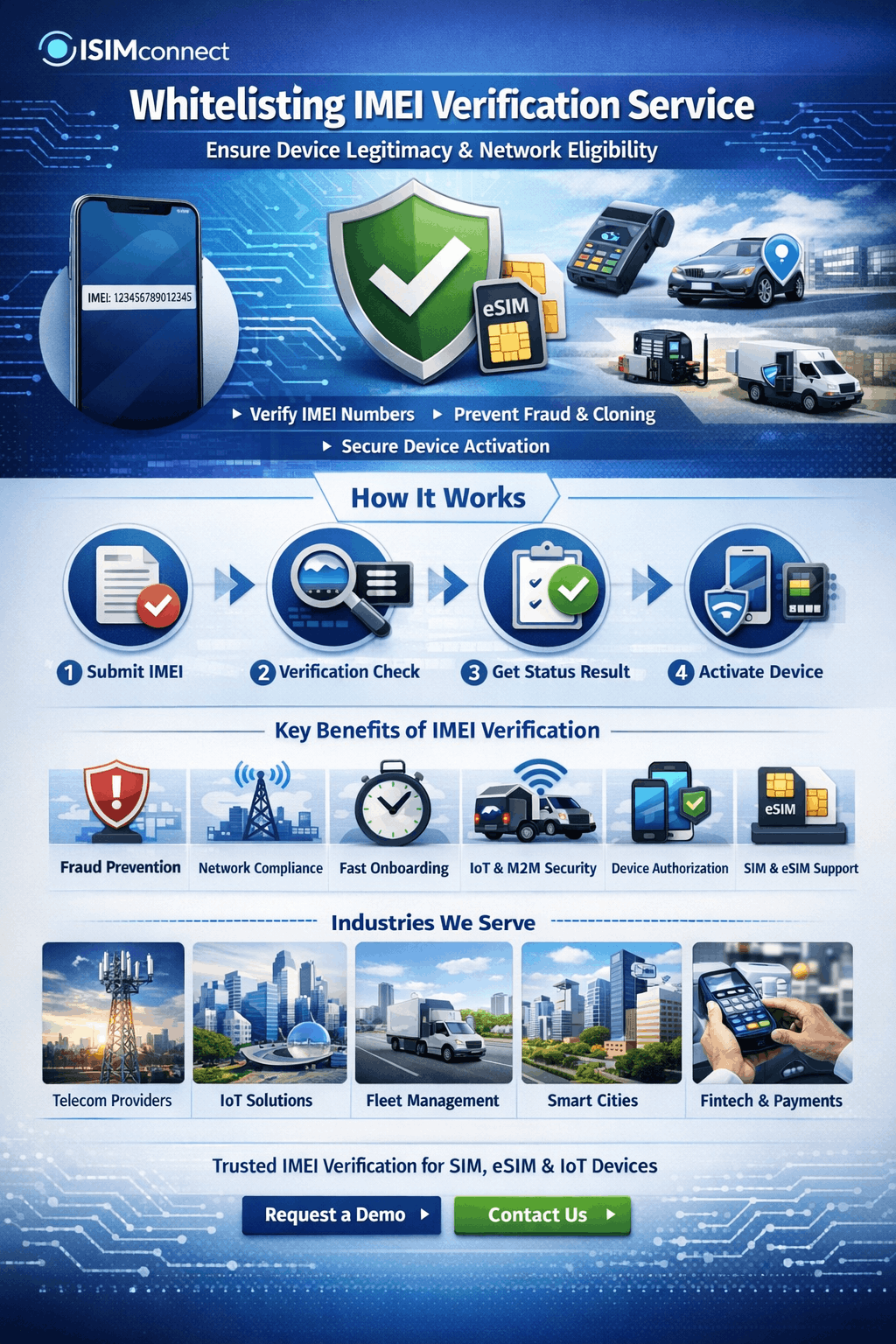
Step 1: Submit IMEI Number
Provide the device IMEI number through your application, portal, or API workflow.
Step 2: Verification Check
The platform performs a secure SIM check and validates the IMEI against authorized records.
Step 3: Status Confirmation
Receive verification results indicating whether the device is eligible for use across supported mobile networks.
Step 4: Proceed with Activation
Proceed to activate SIM card, activate SIM, or activate eSIM services with greater confidence.
Benefits for Businesses
Improve Security
Reduce the risk of unauthorized devices accessing network resources.
Enhance Customer Experience
Provide smoother onboarding and fewer activation failures.
Increase Operational Efficiency
Automate verification processes and improve SIM management workflows.
Support Regulatory Compliance
Help meet telecom and industry compliance requirements.
Reduce Activation Failures
Validate devices before SIM card activation and eSIM activation.
Strengthen Device Lifecycle Management
Maintain visibility and control over connected devices while helping organizations efficiently manage devices across large deployments.
Common Use Cases
Pre-activation compliance: Verify IMEI whitelist status before activating a SIM on a device — prevent activating SIMs on blocked or non-compliant devices
Imported IoT device clearance: Check IMEI registration for imported IoT hardware before deployment on Indian networks — catch CEIR compliance issues before SIM provisioning
Fleet device auditing: Bulk-verify IMEI status across an existing fleet to identify any devices that have been blocked since deployment
SIM fraud prevention: Detect SIM cards being used in blacklisted devices — a signal of potential SIM fraud or theft
Refurbished device screening: Verify IMEI whitelist status before activating SIMs in refurbished or second-hand enterprise IoT hardware
Industries That Benefit from IMEI Whitelisting Verification
Telecommunications Providers
Validate devices before SIM and eSIM activation.
IoT Solution Providers
Verify connected devices deployed across large-scale IoT SIM and M2M SIM networks.
Fleet Management Companies
Ensure authorized vehicle tracking devices remain operational.
Smart City Projects
Support secure deployment of connected infrastructure.
Fintech and Payment Providers
Validate payment terminals and connected devices.
Logistics and Supply Chain Companies
Improve visibility and control over connected assets.
Enterprise Mobility Providers
Manage corporate device fleets more effectively.
Healthcare Technology Providers
Support secure connectivity for medical and monitoring devices.
Why Choose ISIMconnect?
With ISIMconnect You Get:
Reliable IMEI verification capabilities
Advanced SIM verification services
SIM and eSIM expertise
Enterprise-grade connectivity solutions
Scalable deployment options
Seamless API integration
Faster onboarding workflows
Enhanced SIM management support
Dedicated technical assistance
Our solutions help businesses simplify connectivity operations, improve security, optimize device activation processes, and support large-scale deployments across modern mobile ecosystems.
Frequently Asked Questions
Q: What is IMEI whitelisting in India?
A: IMEI whitelisting refers to a device’s registration in India’s Central Equipment Identity Register (CEIR) maintained by DoT as “approved” for network access. Devices with non-whitelisted IMEIs can be blocked from Indian operator networks. ISIMConnect’s IMEI Verification API queries CEIR to check whether a device is whitelisted, blacklisted, or greylisted before SIM provisioning.
Q: What is the difference between IMEI and IMSI?
A: IMEI identifies the physical device (the hardware) — it stays with the device even if the SIM is changed. IMSI identifies the subscriber/SIM profile — it changes if the SIM is changed. For IoT, IMEI identifies which specific device is on the network; IMSI identifies which operator subscription that device is using.
Q: Why do I need IMEI verification before activating IoT SIMs?
A: In India, devices with non-whitelisted IMEIs can be blocked from operator networks — including after activation. Verifying IMEI status before SIM activation prevents provisioning SIMs onto devices that will be blocked, avoiding wasted activation costs and operational disruptions.