SGP.32 eSIM — GSMA IoT Remote Provisioning for Embedded Hardware
Overview
ISIMConnect’s SGP.32 eSIM is a GSMA SGP.32-compliant eUICC chip in MFF2 form factor — soldered directly to a device’s circuit board at manufacture — enabling full remote SIM provisioning for IoT and M2M devices. It delivers the same over-the-air operator profile management as the SGP.32 Plastic SIM, with the added advantages of the MFF2 embedded form factor: tamper resistance, industrial-grade environmental sealing, and no physical SIM slot requirement in the device design.
What Is an eUICC and How Does It Enable SGP.32?
eUICC (Embedded Universal Integrated Circuit Card) is the hardware standard that enables remote SIM provisioning on embedded chips. An eUICC chip can store, download, and switch operator profiles under software control — whereas a standard embedded SIM chip (non-eUICC) has its profile fixed at manufacture and cannot be remotely updated.ISIMConnect’s SGP.32 eSIM is an eUICC chip implementing the GSMA SGP.32 specification — meaning it supports the asynchronous, device-triggered remote provisioning model designed specifically for IoT fleets. This is distinct from a standard Multi-IMSI MFF2 chip, which stores multiple pre-loaded profiles but cannot receive new profiles over the air.
Who Should Choose SGP.32 eSIM Over SGP.32 Plastic SIM
Choose SGP.32 eSIM when:
Your device does not have a physical SIM slot, or you are designing a new device where removing the SIM slot reduces cost or complexity
Your deployment environment is outdoor, high-vibration, or exposed to moisture, dust, or temperature extremes where a removable SIM connector is a reliability risk
Tamper resistance is a security requirement — the embedded chip cannot be physically removed from a deployed device
You are manufacturing at scale and want to reduce BOM (bill of materials) cost and assembly complexity by eliminating the SIM socket
Choose SGP.32 Plastic SIM when your device already has a SIM slot and embedding is not required or practical.
How SGP.32 Remote Provisioning Works on the eSIM
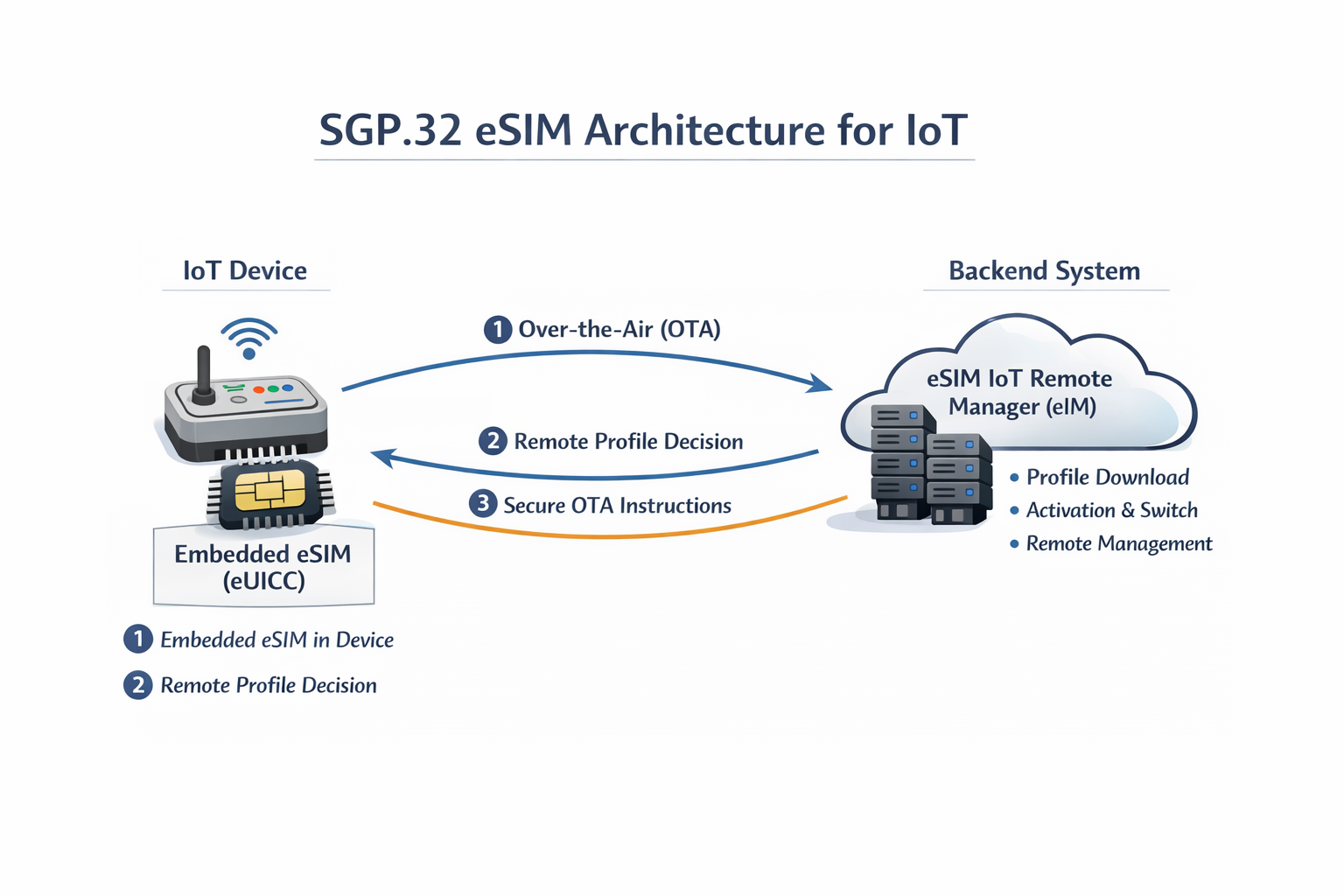
Board integration: The MFF2 eUICC chip is soldered to the device PCB at manufacture, eliminating the physical SIM slot from the design.
Bootstrap: On first power-on, the pre-installed bootstrap profile connects the device to the network and to the ISIMConnect eIM server.
OTA profile download: The eIM delivers the designated operator profile (Airtel, Jio, Vodafone, or BSNL) to the eUICC chip over the air — no physical access to the device required.
Lifetime management: Operator switches, plan changes, and regional expansions are handled remotely via the eIM throughout the device’s operational life.
Asynchronous queuing: If the device is offline when a profile update is triggered, the update queues in the eIM and applies on next connection — no timing dependency.
Specifications
GSMA standard – SGP.32 (current IoT RSP specification)
Hardware type – eUICC (Embedded Universal Integrated Circuit Card)
Form factor – MFF2 (surface-mount, solderable to PCB)
Network operators – Airtel, Jio, Vodafone Idea, BSNL + global roaming
Profile management – Remote OTA via ISIMConnect eIM
Operation mode – Asynchronous — offline-compatible profile updates
Environmental rating – Industrial-grade — sealed, vibration and corrosion resistant
Tamper resistance – High — permanently soldered, cannot be removed
Security – SGP.32-compliant encrypted profile transactions
Personalization – SAS-accredited facilities, GSMA security protocols
Key Benefits
Full remote operator profile management throughout the device’s entire field life
No physical SIM slot required — reduces device design complexity and BOM cost
Industrial-grade MFF2 packaging — resistant to vibration, moisture, dust, and temperature extremes
Tamper-resistant — permanently embedded, cannot be physically removed or swapped
Asynchronous SGP.32 provisioning — works with battery-powered, intermittently connected devices
GSMA SGP.32 compliance for operator onboarding and enterprise procurement requirements
SIM personalization at SAS-accredited facilities under GSMA security protocols
Common Use Cases
Automotive telematics and connected vehicle systems where vibration resistance and tamper prevention are critical
Smart meters and utility infrastructure requiring permanent, tamper-evident connectivity
Industrial IoT equipment in harsh environments — manufacturing floors, outdoor installations, cold chain logistics
Medical and healthcare IoT devices where SIM accessibility is a security or regulatory concern
EV charging networks requiring long-term, remotely managed operator relationships
Smart city infrastructure — environmental sensors, traffic management, public lighting systems
Globally manufactured devices shipped across regions where operator profiles are assigned post-deployment
SGP.32 eSIM Requires eIM
Like the SGP.32 Plastic SIM, the SGP.32 eSIM requires an eIM (eSIM IoT Remote Manager) to orchestrate profile downloads and lifecycle management. ISIMConnect provides and manages eIM infrastructure — you access it via the Connection Management Platform and API, without hosting your own server.
See the eIM product page →
Frequently Asked Questions
Q: What is the difference between SGP.32 eSIM and Multi-IMSI eSIM — they both look like the same MFF2 chip?
A: They share the same MFF2 physical form factor but work fundamentally differently. Multi-IMSI eSIM stores multiple operator profiles at manufacture time and switches between them on-device — no remote provisioning possible. SGP.32 eSIM is an eUICC chip that supports GSMA SGP.32 remote provisioning, meaning new operator profiles can be downloaded and activated over the air after the device is deployed. If you need to change operators post-deployment, only SGP.32 eSIM supports that.
Q: Does the SGP.32 eSIM require a SIM slot in the device design?
A: No. The MFF2 chip is soldered directly to the PCB during device manufacture, eliminating the need for a SIM card slot. This is one of the key reasons to choose the eSIM form factor — it reduces device design complexity and eliminates a potential failure point.
Q: Which Indian network operators does SGP.32 eSIM support?
A: Airtel, Jio, Vodafone Idea, and BSNL — with global operator support available for cross-border IoT deployments through ISIMConnect’s roaming partnerships.
Q: Is SGP.32 eSIM suitable for outdoor or vehicle-mounted hardware?
A: Yes. The MFF2 packaging is vacuum-sealed and soldered, making it resistant to moisture, dust, vibration, and temperature extremes — properties that removable plastic SIM cards and their connectors cannot reliably match in harsh environments.
Q: Do I need to manage the eIM infrastructure myself?
A: No. ISIMConnect provides and operates the eIM server. You manage SGP.32 profiles through ISIMConnect’s Connection Management Platform and REST API — without building or hosting your own eIM.
Q: What is the operational lifecycle of an SGP.32 eSIM?
A: The MFF2 chip is rated for industrial-grade durability and long operational lifecycles — suitable for IoT devices expected to remain in service for five or more years. Remote provisioning means operator profiles can be updated as needed throughout that entire lifecycle without physical access to the device.