SGP.32 Plastic SIM — GSMA IoT Remote Provisioning in a Standard SIM Card
Overview
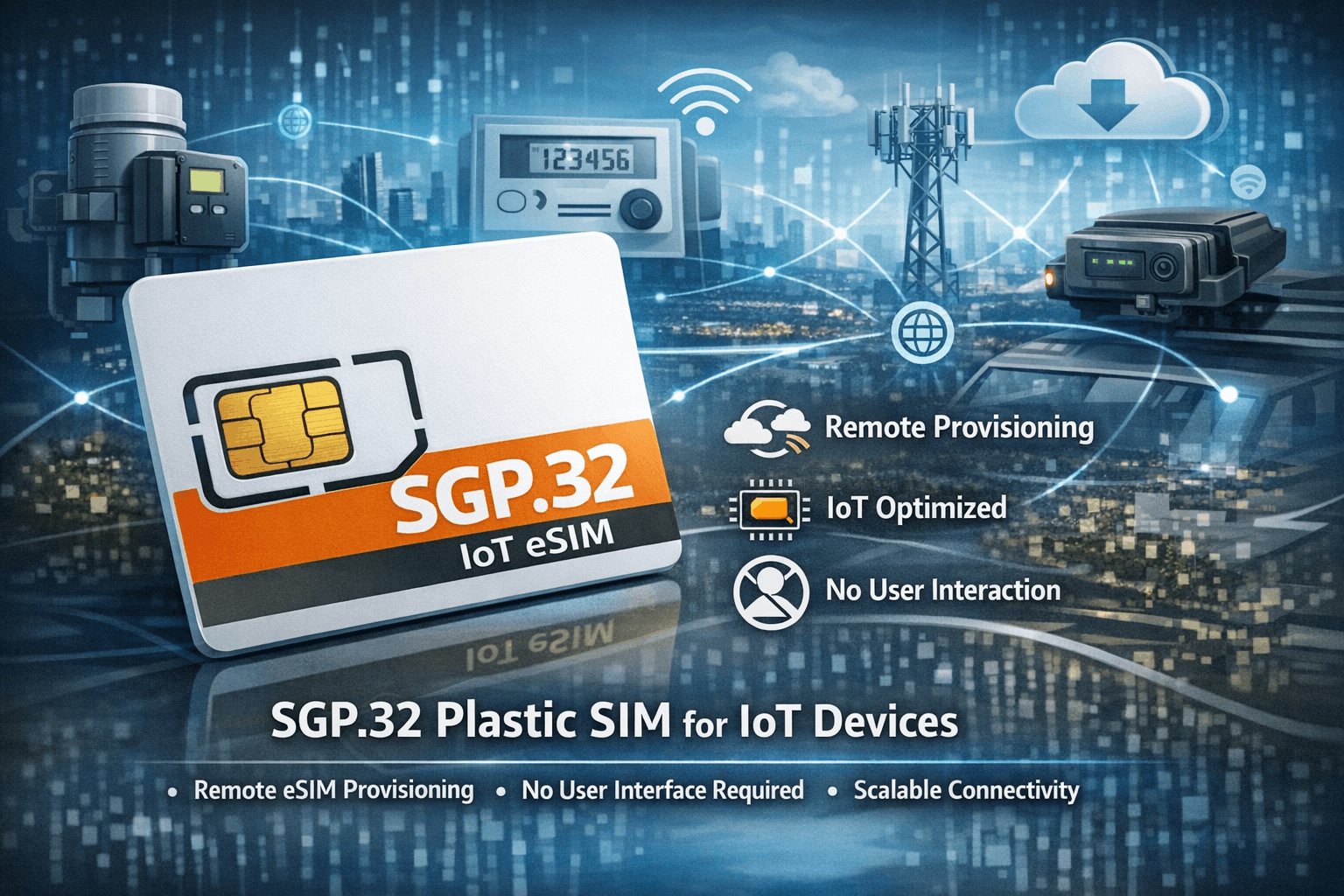
ISIMConnect’s SGP.32 Plastic SIM is a removable SIM card — available in 2FF, 3FF, and 4FF form factors — that implements the GSMA SGP.32 standard for IoT remote SIM provisioning. It allows operator profiles to be downloaded, activated, and changed over the air after the device is deployed in the field, without any physical SIM replacement or technician visit. It connects to Airtel, Jio, Vodafone, and BSNL networks in India, with global operator support for cross-border deployments.
Who Should Choose SGP.32 Plastic SIM
This is the right product when:
Your device has a standard physical SIM slot (no embedded chip required)
You need the ability to change operators, plans, or profiles remotely after deployment — not just at manufacture
Your deployment spans multiple countries or operator regions where requirements may shift over the life of the device
You need GSMA SGP.32-standard compliance for operator relationships, enterprise procurement, or regulatory requirements
If your devices do not have a physical SIM slot, or are deployed in rugged/outdoor environments where a removable SIM is impractical, the SGP.32 eSIM (MFF2 embedded chip) is the correct form factor.
If you need multi-network connectivity immediately on first power-on without remote provisioning infrastructure, Multi-IMSI Plastic SIM is a simpler alternative.
How SGP.32 Remote Provisioning Works on This SIM
Bootstrap: On first power-on, the SGP.32 Plastic SIM uses its pre-installed bootstrap profile to connect to the network and reach the ISIMConnect eIM server.
Profile download: The eIM pushes the designated operator profile (Airtel, Jio, Vodafone, or BSNL) to the SIM over the air — the device receives its permanent connectivity without any physical access.
Lifecycle management: As your deployment evolves — new regions, carrier switches, plan upgrades — updated profiles are pushed remotely through the eIM with no SIM swap required.
Asynchronous operation: If the device is offline when a profile update is triggered, the update queues in the eIM and is applied the next time the device connects — no timing dependency.
Specifications
GSMA standard – SGP.32 (current IoT RSP specification)
Form factors – 2FF (Mini), 3FF (Micro), 4FF (Nano)
Network operators – Airtel, Jio, Vodafone Idea, BSNL + global roaming
Profile management – Remote download, activation, switch via eIM
Operation mode – Asynchronous — queued updates for offline devices
Security – SGP.32-compliant encrypted profile transactions
Personalization – SAS-accredited facilities, GSMA security protocols
Management platform – ISIMConnect eIM + Connection Management Platform
Key Benefits
Full operator flexibility post-deployment — change carriers or plans without a SIM swap
Asynchronous provisioning — works with devices that are intermittently connected or battery-powered
Single SIM card works across Airtel, Jio, Vodafone, and BSNL via remote profile switching
GSMA SGP.32 compliance satisfies enterprise procurement and operator onboarding requirements
SIM personalization at SAS-accredited sites under GSMA security protocols
Centralized management via ISIMConnect’s Connection Management Platform and eIM API
Common Use Cases
Smart metering across multiple utility operators requiring long-term profile management
Fleet telematics with multi-region expansion planned after initial deployment
EV charging stations requiring operator switching as commercial agreements evolve
Industrial IoT sensors in fixed locations where physical SIM replacement is operationally costly
Connected healthcare and logistics devices requiring auditable SIM lifecycle management
Important: SGP.32 Plastic SIM Requires eIM
SGP.32 profile management is not a standalone capability — it requires an eIM (eSIM IoT Remote Manager) server to orchestrate profile downloads and switches. ISIMConnect provides eIM as a dedicated product. If you are evaluating SGP.32 SIM, evaluate eIM alongside it.
See the eIM product page →
Frequently Asked Questions
Q: What is the difference between SGP.32 Plastic SIM and SGP.32 eSIM?
A: Both implement the same GSMA SGP.32 remote provisioning standard. The Plastic SIM is a standard removable SIM card fitting a physical SIM slot in 2FF, 3FF, or 4FF form factors. The eSIM is a surface-mount MFF2 chip soldered to the circuit board, suited for compact, ruggedized, or tamper-resistant hardware where a removable SIM is not practical.
Q: Do I need to set up eIM myself to use SGP.32 Plastic SIM?
A: No — ISIMConnect provides and manages the eIM infrastructure as part of the SGP.32 SIM product. You access profile management via ISIMConnect’s Connection Management Platform and API, without having to build or host your own eIM.
Q: Can SGP.32 Plastic SIM connect to Jio and Airtel networks?
A: Yes. ISIMConnect’s SGP.32 platform supports Airtel, Jio, Vodafone Idea, and BSNL for Indian deployments, with global operator support available for cross-border IoT fleets.
Q: What happens if my device is offline when a profile update is triggered?
A: The profile update queues in the ISIMConnect eIM and is applied the next time the device connects to the network. SGP.32’s asynchronous design means you do not need the device to be online at the exact moment of provisioning — a key advantage over older M2M SIM provisioning standards.
Q: Is SGP.32 Plastic SIM better than Multi-IMSI Plastic SIM for my deployment?
A: It depends on your requirements. SGP.32 Plastic SIM is better if you need to change operator profiles after deployment or require GSMA-standard remote provisioning compliance. Multi-IMSI Plastic SIM is better if you only need multiple networks available from first power-on and do not need to change profiles later. SGP.32 requires eIM infrastructure; Multi-IMSI does not.